English Resume: Compare The Element
Objective:
·
Exploring
element and compounds
Vocabulary:
·
Element
·
Compound
·
Matter
·
Periodic
table
·
Compare
·
Contrast
Background:
All
known substances can be classified as solids, liquids, gases, or plasma. In
addition, a fifth state of matter, the Bose-Einstein condensate has been
discovered recently. However, it is not stable at normal earth conditions.
Likewise, although plasma is the most abundant state of matter in the Universe,
it is not common on the Earth under normal conditions, except for lightning.
Most matter that students are familiar with will therefore be in a solid,
liquid, or gaseous state.
An
element is a pure substance that cannot be decomposed into simpler substances
by normal chemical means. There are 109 different elements. Ninety of these are
naturally occurring; the rest have been created in laboratories. Elements 110
and 118 are still being researched on. There will be more elements as
technology can identify them. A symbol is used to represent the full name of an
element. For example, H represents hydrogen; O represents oxygen, and Al
represents aluminum. Sometimes the Latin name for an element is used as the
basis for its symbol, for instance K represents potassium (kalium in Latin).
Three
subatomic particles compose elements: protons, neutrons, and electrons.
Protons, which have an electrical charge of +1, and neutrons, which have a
neutral charge, make up the nucleus of an element. This nucleus is surrounded
by a "cloud" of electrons, each of which as a charge of -1. The
electrons spin around the nucleus in what are called orbits or shells. Each of
the orbits can contain a set number of electrons. For instance, the first
orbital from the nucleus has 2 electrons, the second has 8, the third has 8,
the 4th has 16 and the fifth has 32, and so on. Each shell may not be full,
depending on the number of electrons in the element, and the inner shells fill
before the outer shells fill. Sodium, for example, has 11 electrons, which are
located in the first, second, and third shells (2+8+1.)
An
element has a uniform composition. Different elements may join together; these
combinations are called compounds. A compound can be separated into its
component elements by chemical means. For example, common table salt is a
compound made of two elements: sodium and chlorine. Table salt can be broken
down into sodium and chlorine by mixing it with water. However, sodium and
chlorine cannot be easily broken down into any simpler forms.
Each of the five reaction
chemistries can be considered to be a paradigm,
where a paradigm is a particular theoretical framework or way
of thinking. The result is that it can be difficult to think in terms
of more than one of the five reaction chemistries at the same time.
Consider the hydride ion, H–.
The hydride ion is a Lewis base and as such the the hydride ion can be
qualitatively compared with other nucleophilic and proton abstracting Lewis
bases:
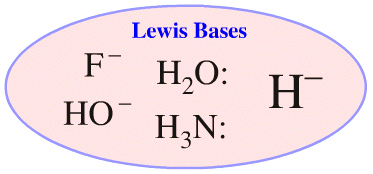
We can ask questions such as
"is the hydride ion a good proton abstractor, is it a good nucleophile and
does it ever act as a spectator ion?" When asking questions like these we
can compare the hydride ion with other Lewis bases such as ammonia, dialkyl
ethers, fluoride ion and hydroxide ion. (Note that the hydride ion is not
congeneric with these other Lewis bases.)
The hydride ion, H–, is
also a reducing agent and it can be compared with other reducing agents such as
the electron, electron donating metals and electron donating metal ions:
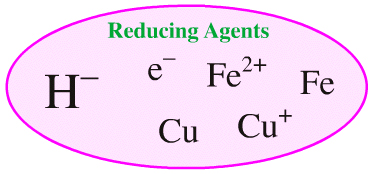
But, the set of all Lewis bases
cannot be compared with the set of all reducing agents as illustrated by a Venn
diagram:
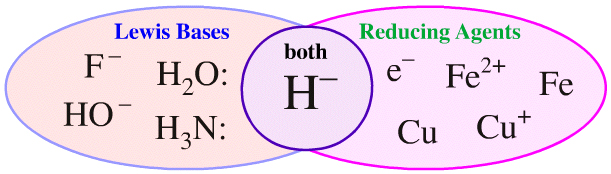
Of the species above, only the
hydride ion is both a Lewis base and a reducing agent. While it is possible to
compare and contrast Lewis bases with other Lewis bases, and it is possible to
compare and contrast reducing agents with each other, it is not possible
to compare and contrast the set of Lewis bases and the set of reducing agents
at the same time.
Likewise,
• The proton, H+, is a
Lewis acid and an oxidising agent.
• Dioxygen, O2, is a diradical and
an oxidising agent.
• Photochemical methods can convert
triplet diradicals into singlet diradicals.
• The benzene radical cation, [C6H6]+•,
is both a radical and a Lewis acid.
• Photochemical and redox methods
can be used to produce radicals.
There are many examples
like this in reaction chemistry space.


Is there any similarity between halogens and other elements in the periodic system of elements?
BalasHapusWe know, . A compound can be separated into its component elements by chemical means.give me example please linggo 😁?
BalasHapusliggo , give me one example of contrasting element between group 3A with Halogen
BalasHapusthanks
Can you explain the privilege of halogen elements ??
BalasHapuslinggo, Elements are pure substances that can not be decomposed into simple substances by normal chemical means, why can not the substance can be decomposed into simple substances by normal chemical means?
BalasHapuswhat is the Five Reaction Chemistry Paradigms?
BalasHapusIs there any element that harmful to human? please explain that
BalasHapuscan you compare use of nitrogen and oxygen ?
BalasHapus