English Resume: Chemical Classification of Matter
Introduction
The classification of matter into solids, liquids and gases is termed physical classification of matter. Solid, liquid and gas are the three state of matter. Thus, matter exist inthree physical states: gas, liquid and solid. Solids under ordinary conditions have definite volume and shape, and tend to maintain these even under deforming forces.

Liquids also have definite volume but take the shape of the vessel into which they are poured. Both the liquids and solids are nearly incompressible. Gases, on the otherhand, maintain neither the volume nor shape, and completely fill the container into whichthey are introduced. Gases can be expanded or compressed very easily
The three states of matter are interconvertible. This can be done by heating or cooling. Heating increases the interparticle spacing and the kinetic energy of the particles. So, a solid on heating gets converted into a liquid, and a liquid into a gas.
Many properties of solids, liquids and gases can be easily observed with the help of our sense organs. The properties which can be observed with the help of our sense organs are called macroscopic properties. The description of the behaviour of the three states of matter in terms of atomic theory is called microscopic description of matter. In chemistry explain the macroscopic behaviour of matter in terms of its microscopic ription. In this chapter, we would try to explain the observable properties of different states ofmatter in terms ofthe behaviour of the constituent particles in them.
The universe is made of matter and energy. Although, matter and energy are interconvertible, but while the matter => energy transformation can be seen, the energy => matter conversion can not. The most familiar forms of energy are heat and light.
Matter
The matter as defined as something that occupies space, possesses mass and of ersresistance to any stress applied on it. Different kinds of matter are made up of different substances. A substance is a definite variety of matter, all samples of which have the same properties.
Substances have two major types of properties, viz physical and chemical The physical properties describe any substance as it is, e.g. ,shape, hardness or softness, melting point and boiling point etc.
The chemical properties describe the ability of any substance to change into new substance or substances.
The physical and chemical properties form the basis of classification of matter in the following two ways.
a) Classification of matter on the basis of physical properties; Physical of classification of matter.
b) Classification of matter on the basis of chemical properties; Chemical classification of matter.

Physical classification of matter
Based upon the physical characteristic of matter, it is classified into three states, viz, solids, liquids and gases.
In solids, the partieles are closely packed and bound by strong interparticle attraction. This makes solids rigid and geometrical,
ln liquids, the particles are loosely packed and are bound to each other with forces weaker than those in solids This makes liquids mobile and shapeles.
In gases, the particles are separated fiom each other by much greater distances, almost 10 to 100 times the size of the particle. Thus, there is virtually no force of attraction between the particles (in fact, in gases the operating forces are very weak).
As a result, the particles in gases are so loosely packed that they are free to move in any direction. This makes gases shapeless and highly compressible.
Thus, the have very low kinetic energy and in the particles have very large kinetic energy.
The three states of matter are interconvertible. This can be affected by heating/aooling. Heating increases the kinetic energy of the particles. As a result, a solid on heating can be converted into a liquid, and a liquid into a gas, Effect of heating on the interparticle spacing, and hence the physical state is shown in Fig. 2.1.
Solids, liquids and gases differ from each other in certain properties. A comparison of the properties of solids, liquids and gases is given below.
Chemical classification of matter
A complete classification of matter into fundamental groups was (and also is) a very difficult task. On the basis of chemical composition the matter exists either as a single substance or, as a mixture containing two or more substances. A sample containing only one substance is called a pure substance. A pure substance shows the following characteristics:
1. A pure substance contains only one kind of atoms or molecules.
2. A pure substance is perfectly homogeneous.
3. A pure substance has a definite composition which does not change with time.
Pure substances can be further classified into;
A. Elements
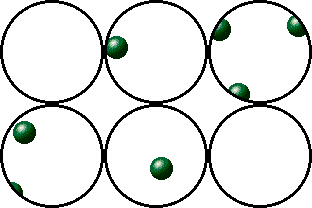 |  |
Microscopic view of the atoms of the element argon (gas phase).
|
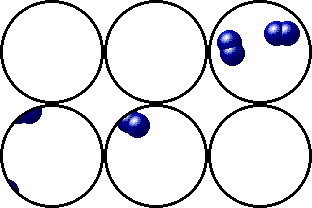
Microscopic view of the molecules of the element nitrogen (gas phase).
|
Note that an element:
- consists of only one kind of atom,
- cannot be broken down into a simpler type of matter by either physical or chemical means, and
- can exist as either atoms (e.g. argon) or molecules (e.g., nitrogen).
A molecule consists of two or more atoms of the same element, or different elements, that are chemically bound together. Note that the two nitrogen atoms which comprise a nitrogen molecule move as a unit.
B. Compounds
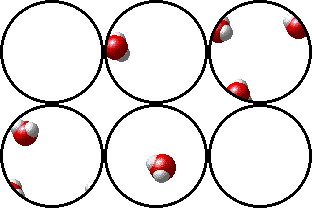
Microscopic view of the molecules of the compound water (gas phase). Oxygen atoms are red and hydrogen atoms are white.
|
Note that a compound:
- consists of atoms of two or more different elements bound together,
- can be broken down into a simpler type of matter (elements) by chemical means (but not by physical means),
- has properties that are different from its component elements, and
- always contains the same ratio of its component atoms
Mixtures
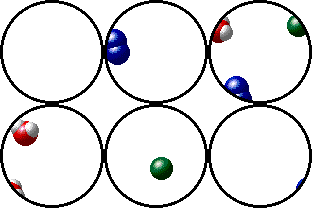
Microscopic view of a gaseous mixture containing two elements (argon and nitrogen) and a compound (water).
|
Note that a mixture:
- consists of two or more different elements and/or compounds physically intermingled,
- can be separated into its components by physical means, and
- often retains many of the properties of its components.
Samples containing more than one substances are called mixtures. There are two types of mixtures.
(a) Homogeneous mixtures, (b) Heterogeneous mixtures
A homogeneous material is that substance which is perfectly uniform in its composition throughout A heterogeneous material is the one which has different composition, and different properties in different parts of the sample.
You can see more explaining in video by SchoolPage:
Source:
Sharma, RK. 2007. Elementary Chemistry. New Delhi: Discovery Publishing House
Cracolice, Mark, and Edward Peters. Introductory Chemistry. 3rd ed. Mason, Ohio: Cengage Learning, 2008.
Petrucci, Ralph, Harwood,William, Herring, Geoffrey, Madura, Jeffry, General Chemistry: Principles & Modern Applications, 9th ed. Upper Saddle River, New Jersey: Pearson Prentince Hall, 2007.C.N. Hurley, W.L. Masterton, Chemistry: Principles and Reactions, 6th ed.
Brooks/Cole Cengage Learning, Belmont, Calif., 2004.
Zumdahl, Zumdahl, DeCoste, World of Chemistry, Houghton Mifflin Company, Boston, Massachusetts, 2002.
https://www.schoolpage.me/the-difference-between-atoms-elements-molecules-compounds-and-mixtures/ (diakses tanggal 16 April 2017)
https://www.chem.purdue.edu/gchelp/atoms/elements.html (diakses tanggal 16 April 2017)
https://chem.libretexts.org/Core/Analytical_Chemistry/Qualitative_Analysis/Classification_of_Matter (diakses tanggal 16 April 2017)


How we can know that the things identifically as compound or mixture when we just look physically of the things ?
BalasHapusIn my opinion, i explain about;
BalasHapusCompound: It can't see a colour anything. There is two or more different atoms bonded together A molecule or a group of identical molecules, but it can chemist reaction. For the example H2+1/2O2=>H2O.
Mixture: it can see a discoloration or changing colour. There is two or more different atoms or molecules together but not joined (they're not covalently bonded).For Example in house daily we mix the coffee powder plus water => it become liquid coffee.
A sample containing only one substance is called a pure substance. A pure substance shows the following characteristics. please expain about that?thnks
BalasHapusThe things of pure substance can work with chemical reaction. For the example nitrogen plus nitrogen, equation N2 (element) or hydrogen plus sulfate it become hydrogen sulfate compound
BalasHapusso everything in this world created by matter ?
BalasHapusgive your opinion linggo
What the different between pure and mixture? Please explain that
BalasHapusCan you explain why matter is so important to human life?
BalasHapus